Episode 016: Great Writers Edit; Bad Writers Discuss Editing on a Podcast is now online, part of The Velvet Podcast series. Joining me on this panel are authors Gavin Pate (The Way to Get Here), Richard Thomas (Transubstantiate), and moderator Caleb J. Ross (Stranger Will).We discuss the editing of prose fiction, detailing our own processes, insights, pitfalls, and experiences, while discovering new methodologies and techniques for making this dreaded task more enjoyable and effective.
To coincide with today’s release of Warmed and Bound: A Velvet Anthology, I created this promo. It’s composed of imagery inspired by stories in the collection, including original music from me. The intent is to evoke a feeling, a mood—ominous, violent, and redemptive—rather than paint specific settings or characterizations. Multi-plane animation (a.k.a. “2.5-D”) was used to breathe life into what are predominately still photos. I’m so proud to have a story included alongside so many talented and respected authors in what has to be one of the year’s best.
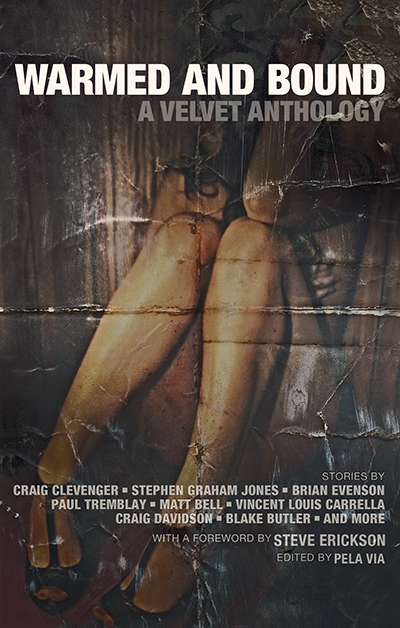
My story “Headshot” will be featured in Warmed and Bound: A Velvet Anthology, available July 22 in paperback and e-book from your favorite online bookseller.
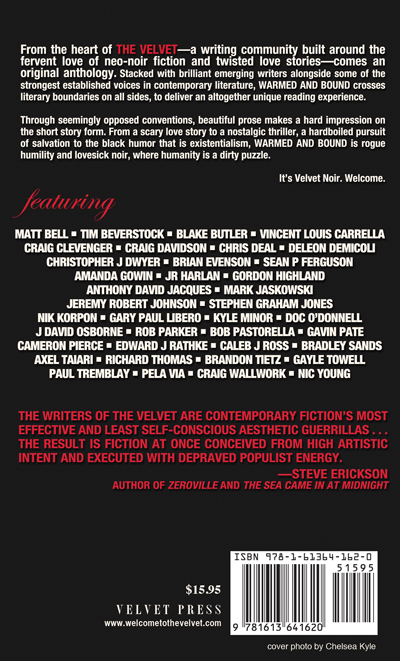
This project has been a labor of love, born out of a reading/writing community called The Velvet (where I’m a moderator), who are united by their love of dark, visceral fiction exemplified in the works of authors Will Christopher Baer, Craig Clevenger, and Stephen Graham Jones. Many other published authors and emerging writers make up the talent pool as well, and when the time finally came to assemble a collection of their work, our editor Pela Via and admin Logan Rapp led the charge. With participation from Clevenger, Jones, and the regulars, we reached outside our community to a number of authors with similar sensibilities we respect like Brian Evenson, Craig Davidson, Matt Bell, Blake Butler, Jeremy Robert Johnson, Paul Tremblay, Vincent Louis Carrella, and others, and were delighted with their response. There’s even a short foreword by Steve Erickson, whose work is praised within our walls nearly as often as that of our founders.
Here’s a peek at the cover. Click for larger versions and to see the full list of contributors.
Visit the official Warmed and Bound site for more info and updates, be sure to “like” its Facebook page, add it to your Goodreads shelf, and I’ll be posting some related media here in the upcoming weeks.
This is a guest post by Caleb J Ross as part of his Stranger Will Tour for Strange blog tour. He will be guest-posting beginning with the release of his novel Stranger Will in March 2011 to the release of his second novel, I Didn’t Mean to Be Kevin and novella, As a Machine and Parts, in November 2011. If you have connections to a lit blog of any type, professional journal or personal site, please contact him. To be a groupie and follow this tour,subscribe to the Caleb J Ross blog RSS feed. Follow him on Twitter: @calebjross.com. Friend him on Facebook: Facebook.com/rosscaleb
When I was younger, I took comfort in open-ended answers from my teachers and professors. I’d ask about the serial comma rule or how to handle semi-colons and answers would vary from the dismissive (“Nobody really knows when to use the serial comma”) to the Socratic (“How do you feel you should use semi-colon?”). This level of freedom with language was something I had never experienced before. It felt good to realize just how little in this world could be definitely right or wrong.
But it got old. After graduating college I suddenly found myself having to provide actual answers. When in school, the future is a vague, ever-distant destination. Post school, the destination suddenly becomes the present. Answers are important; philosophizing about them is not. The desire for absolutes extended beyond the grammatical and into the professional. So today, for fiction writers suffering the same confusion as I have (and still do, in many respects), below is a list of absolutes. Take comfort.
1. Use the word “that” 97% less than you do right now. “That” is a buffer word and usually serves to clog the flow of a sentence. Find a way around it.
2. Replace almost every instance of a “to be” verb with something else. The difference between the right verb and the almost right verb is the difference between a right sentence and a wrong sentence. Go for active verbs and you will get engaged readers.
3. Avoid “(blank) of the (blank)” phrase constructions (e.g. “chicken of the sea”). These phrases usually indicate weak metaphors. Much of the time, the phrasing can be changed for better impact (e.g. “sea chicken”). Always use as few words as possible to tell a story.
4. Read only one publishing how-to book, if you must read any. No more than one. Be wary of publishers who make their money by selling tools to writers. If you’ve read a handful of Writer’s Digest how-to write, how-to query an agent, how-to submit a manuscript books, you’ve read them all (Christina Katz’s Get Known Before the Book Deal is a definite exception).
I’ve been reading a lot of short story collections this year, and they always take me so much longer to get through than novels. Which I’m certain mirrors their authors’ own experiences creating them. It can be exhausting reading more than one story per sitting, even if it’s just ten pages.
Creative writing instructors often use the iceberg metaphor. Because ice is slightly less dense than water, only 10% of it is visible above the surface. Same thing with characters and their backstories and the universes they inhabit. The portion shown to the reader is merely the tip of said iceberg, but what’s hidden from view is what built up these worlds and enabled this particular story. Musicians make similar claims about subsonic vibrations or overtones that are necessary to support those notes we do hear.
It’s no surprise that when sci-fi crosses over into the mainstream, it tends to be that which isn’t bogged down with proving the feasibility of its technology. Sure, that’s part of the 90% that makes the world run, but what we care about are the characters and our ability to relate to their humanity. Battlestar Galactica, Children of Men, and Gattaca are all great examples of this approach. Viewers assume these fictional societies are functional, so let’s just get on with whatever drama makes this particular event unique in their lives, and leave those schematics and history books underwater.
Anyway, back to shorts. There’s a place for all kinds, but my favorites tend to be those that feel like a biopsy of something larger, that this view through the window could easily be expanded into a novel or even series. It’s not that they literally compact so much detail into such a small space, but that it’s implied — they give us just enough periphery so that if we turn our heads a little, we can’t see the stagehands in the wings or the seams in the set dressing. They did their homework that allows the reader to be immersed in the universe of that story, to hopefully invent some of it for themselves.
Picasso famously once doodled on a napkin for someone, who then balked at his asking price, saying (paraphrased), “But it only took you a minute!” To which he said, “No, madam, it took my whole life.” And that’s how I feel about short stories, as far as what’s on display versus the effort behind their creation. When you read a collection of these stories, you’re taking that entire journey, following a character’s arc to its conclusion, perhaps 20 or 30 times in the same space one novel would occupy. You’re meeting all new people with varying names and motives, in landscapes familiar, foreign, and alien, and in voices close, distant, or unreliable. The happenings may be on a smaller scale, on a smaller stage, but not necessarily with any less consequence. All of those elements had to be considered and conceived by the author, and processed by the reader. And so it’s one story per sitting for me.
I obsess over my sentences (in stories, not blog posts). This makes me an exceptionally-slow writer, as I don’t move on from a paragraph until it’s as polished as can be at that time. One finished page is a really solid evening for me. I prefer this meticulous method to the one most authors employ, which is to spit out a draft as quickly as possible and then spend the bulk of their time on numerous rewrites or revisions. As someone who derives more enjoyment from crafting prose than charting plot points, that’s just too much delayed gratification (I do outline in advance). My way keeps me interested because each time I close the laptop lid I feel a sense of accomplishment, that a section is “done” to the best of my ability, not put off for some future date.
I am, however, jealous of those who can draft very quickly, those whose storyteller brains work faster than their fingers can, and I would gladly attempt that method were I so endowed. Most writers excel at excuse-generation and rationalization by their nature, and with that in mind, I think I’ve recently discovered one reason for my sloth: writing at a computer.
To break out of the habits that result in stale prose, I’m always trying new experiments, be they environmental or biological or timely. One of these is to write longhand, which I do about 25% of the time in little Moleskine. I’ve noticed that I generate more words in less time this way, even though they tend to be rougher. Several months ago, in an effort to lose some el-bees, I started stationary-biking daily. Usually this requires me to crank an iPod at high BPMs and SPLs to maintain the tempo and endurance I need. A couple weeks ago I traded the iPod for my cell phone’s voice recorder, attempting to dictate a scene from my in-progress novel into it.
My expectations were low, even though I understand that a physical activity or some routine task can be an excellent creative kickstarter for writers, something to keep the lower-level brain functions distracted so that the good stuff can sneak out undetected. This has rarely worked for me before, as I’m hyper-focused and thus a lousy multitasker, no matter how menial the chore. Plus, my brain is always spinning with music even in complete silence, looping movie dialogue, or anything else our modern overstimulated senses consume. To my surprise, though, after about ten minutes, the singing voices faded and the scene began coming together a line at a time — winded though it was — a few hundred words over the course of 40 minutes and 11-some miles, with no drop-off in pace like I experience whenever trying to read instead of headbang.
Of course, biking is probably better for brainstorming or outlining than actual prose, because the phrases I come up with are quite rough. It usually takes me a couple of evenings to polish and expand upon what I transcribed after those 40 minutes. Also, I doubt it would be very effective when working with a blank slate, so I need to first know what the scene’s and characters’ objectives are before I begin.
Anyway, the point of this post is that I think I figured out why dictation and longhand allow me to create more in less time. It’s because of the visual factor. On the computer, below and/or above the blinking cursor, I’ve usually got at least 10 other perfectly-legible typed lines of sharp text at about the equivalent of 24-point type (12 pt at 200% zoom) competing for my attention. The urge to revise these is constant, especially when waiting for inspiration to strike on the current sentence. With dictation, your mind is only in the moment. There are no visual/textual distractions at all, and I’m not rewinding the recorder between lines. And with longhand, my cursive is just illegible enough to serve as the equivalent of a blur filter, keeping my attention on the current line and not any premature nostalgia for those that came before.
So give it a try next time you’re in a rut. Change your location, or your schedule, or your diet … or in this case, your medium. Step out of your comfort zone and forget about everything else you wrote before this sentence.
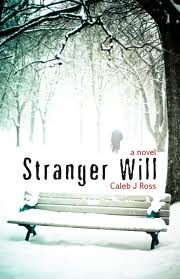
Today as I sat on a park bench scribbling in a Moleskine and trying not to appear suspicious (difficult for a single male my age), irony washed over me as I flashed back to the book I’d read earlier this week, Stranger Will by Caleb J Ross. One element of the story features a cult of aspiring “strangers” who work shifts dressed as bums on benches just like these adjacent to a school playground as part of their indoctrination, while the specially-chosen children in their eyeline learn life lessons of their own from their shared leader, Mrs. Rose. She’s a charismatic Tyler Durden type (both mentor and antagonist) with utopian dreams but dystopian methods who guides our William through the not-so-traumatic experience of losing his unborn child.
That William never wanted to bring a child into this awful world to begin with—even in his fiancée’s last trimester—will make most readers squirm. The point is repeatedly driven home as Will derives much of his outlook from his experiences as a crime-scene cleaner, but these are also what lends the novel its unique quality: the more flawed the character, the greater the possible arc for redemption. We are so repulsed by his refusal to praise the miracle of Life, until we meet other kindred spirits who put his own beliefs in perspective and challenge him to embrace greater ideals. At this point Will becomes more identifiable and sympathetic as he befriends a child at the park who sparks the conflict within him.
While the themes and literary devices employed in the book are reminiscent of Chuck Palahniuk’s early work (it’s also the May selection for discussion at Chuck’s site’s book club), the prose stylings are pure Ross. Dark, disturbing imagery combined with great sensory detail and a grotesque wink now and then. We smell the toxic chemicals of his trade that infuse Will’s entire existence, from wardrobe to vehicle to house. His infected dog bite that festers throughout the story has us scratching at our own arm. He does a masterful job of putting the reader in Will’s head, especially given that the story is written in third-person (a fact I had to verify just now, so close is the point of view to the protag). This is not a beach read; bring it to the doctor’s office or stash it wherever you hide your smokes from your old lady. Discuss it with your friends via carrier pigeon.
As for criticisms, Otherworld Publications is a young press, evident in some editorial errors like typos and such, and hopefully they’ll correct these in future editions. Also, sometimes the cult ideologies that pervade the narrative seem to be in direct opposition to one another, though I think this is probably true to the spirit of those who subscribe to such belief systems, and having that debate play out actually helps us see the conflicts more clearly.
Caleb will be writing a guest post here next month as part of his Tour for Strange blog tour. In the meantime, pick up Stranger Will for yourself, as well as an e-book of last year’s fantastic story collection, Charactered Pieces. Next up for him is another novel, I Didn’t Mean to be Kevin (Black Coffee Press), and a novella, As a Machine and Parts (Aqueous Books), both of which I’ve had the pleasure of reading and pimping thusly.
I’ll be doing a reading and contributing to the general merriment March 4th at the Slap-n-Tickle Gallery in the Crossroads district in Kansas City. Yep, that’s a First Friday, so we’re expecting a great turnout for this music/art/words event featuring the ArtJerk crew.
7:00 – 8:30 pm, fiction readings by myself and: Caleb J Ross, author of Stranger Will Brandon Tietz, author of Out of Touch Michael Sonbert, author of The Never Enders
Shawn Patterson
Episode 9: Does This Novel Make Me Look Fat?, part of The Velvet Podcast series, is now live, featuring discussion about self/vanity publishing. We debate its legitimacy, logistics, and financial aspects, as well as insights from their own experiences in this oft-scorned segment of the industry. I’m joined by authors/panelists Brandon Tietz and Caleb J Ross.
I recently renovated Womb With a View, my home studio, after acquiring a large new desk/console. I used this opportunity to reconfigure and simplify, including wiring up a patch bay for maximum flexibility of its components. This also means that I hopefully will no longer be doing my writing on the same workstation as audio and video. Photo gallery here.
Posted inmusic, news|Comments Off on Womb with a View
Episode 6: Jennifer’s Lost Overboard Body: Cinemuck Boogaloo, part of The Velvet Podcast series is now live for your enjoyment. I handle the hosting duties, featuring panelists Stephen Graham Jones, Logan Rapp, and Jesse Lawrence in a conversation about the big and small screens, both as consumers and creators, cinners and cineastes wading through the Cinemuck.
The premiere episode of The Velvet Podcast is now live. We plan to produce these at least once a month, with a revolving roundtable of writers and readers from all over the world discussing such matters, as well as film, music, and related topics of taste as discussed on the forums at welcometothevelvet.com, where I’m an admin.
The Hawthorne effect suggests that a subject that’s aware it’s being observed will alter its behavior accordingly, that the act of study itself can taint results. When I was contacted by Nielsen to participate in an eight-day study of television viewing habits for sweeps week, my mind immediately fantasized of staging a coup upon all the crap television that tops the weekly ratings and replacing it with the quality programming I watch — that my viewership could single-handedly inject a much-needed shot of taste into the American (Idol) public’s palate.
I keep an occasional eye on the weekly ratings, discouraged that none of the shows I watch, be they broadcast or cable, are even in the top 20 (except for NFL when in season). If you limit this to the 18-45 demographic, I watch two or three at the ass end of the top 20, and several of the most-popular DVRed shows on cable (to me, this implies intelligent viewership). Half of this is explained by my oft-documented disdain for reality television. Still, as this resident of the #32 market counted his five crisp one-dollar bills as payola and began logging the paper diary (not the cool set-top box that some households get), I learned a few things about myself.
I’m a commercial-skipping DVR fiend (you must document both the watched and original times). Over 90% of my time spent in front of the tube is done commercial-free. If I’m unbusy when an HBO series is on, I’ll often watch it at its original broadcast time, recording it anyway, just in case. (I subscribe to HBO strictly for their excellent original series, as nearly any movie I care about has already been Netflixed well before then.) But network and cable programming, even if I want to watch it the same night, I always time-shift it a little. I wait until at least seven minutes past its airtime to “play” a sitcom, or quarter-after for an hourlong drama, which means by the time I catch up with real-time, I’ve been able to FF through the commercials. NFL Sundays, I’ll skip the first hour of a game to get some other tasks done, then restart and power through it in two hours. (I recently read that an average football game contains 11 minutes of snap-to-whistle action; wow.) And not one single minute of local or national news/weather programming was logged.
While I take pride in this efficiency of tube-time, I still watched 18 hours this week. That’s more than I thought, and doesn’t count the two Blu-Rays I rented. And it seemed a fairly typical balance of shows that are in and out of season. As predicted, there were only a few instances of “channel surfing,” though I perhaps did even less than usual because I found myself not wanting to have to log them.
In the end, I doubt my eyeball lobbying for Caprica, Community, Archer, or Big Love will give them even a sniff at the top 20. But you know what they say: if you don’t vote, you can’t complain.
This is a guest post from Caleb J Ross, author of the chapbook Charactered Pieces: stories, as part of his ridiculously-named Blog Orgy Tour. Visit his Web site for a full list of blog stops. Charactered Pieces: stories is currently available from OW Press (or Amazon.com). Visit him at http://www.calebjross.com.
…generally just presenting something semi-publicly is a big thing. And it might, for me, help whatever piece I’m working on if I get some feedback in-progress…as much as this idea [of a workshop] excites me, it also scares me senseless.
Revealing your work for the first time to people (especially friends) can be emotionally debilitating. I’ve been in many critique/workshopping groups over the years, so let me offer some tips that may help alleviate the stress. If these fail, drink.
• You are not your story
Detach yourself from your work. Remember that criticisms are aimed at your writing, not you. Even if the writing is about a personal experience, the criticisms are about how well that experience comes through on the page, not about the validity of the experience. I’ve even had college professors who disallowed participants from engaging directly with the writer and instead insisted on addressing the piece-at-hand. Saying “the story doesn’t work here,” as opposed to “you didn’t do this correctly, here.” This level of structured detachment worked quite well.
• Temper your skin
I always like to stay silent for at least a few minutes at the beginning of my story’s discussion, allowing the other workshoppers to converse before I voice any opinion. One thing that always breeds unnecessary conflict is the writer/artist’s defense of a work. Don’t defend your work, unless you are asked directly to by one of your peers. The workshop is about discovering how well you communicate an idea, not about what you intended to do with the idea. If the workshoppers are confused, be open to the possibility that your story may be unnecessarily confusing.
• Less is usually more
Above all, remember that every participant is workshopping to help get a better product out of you. The criticisms might hurt, especially when you think a particular passage or line is perfect, but sometimes you have to “kill your darlings,” as William Faulkner said. He was referring to murdering children, I believe, but the advice translates well enough. I can count a handful of lines that I stripped out of Charactered Pieces before it printed. The positive spin, though, is knowing that I’ll be able to give those lines to a more fitting story somewhere in the future; if they truly are good, then they won’t die.
• You need some alone time
It is easy to get intimate with a project. And perhaps, the more homely (re: room for improvement) the easier it is to drink into a courthouse wedding and hole up in the nearest trailer. This to say, the writer is with his project for a long time. Often, perhaps always, this intimacy promotes a skewed perspective on the work. The writer unwittingly learns to overlook flaws and convince himself that obvious faults are “creative” or his “style.” Fresh eyes, even if they disagree with what you may perceive, are often the best way to reset your own eyes. Trust the criticisms, even if they hurt.
• Sometimes it’s not you, it’s them
Finally—but take this piece of advice sparingly—it’s okay to disagree with the workshoppers. I say use this advice in moderation, because my experience tells me that the crowd is usually right. Or if not right, they touch on things that need to be addressed in some way. Sometimes the particular individuals in your group may be wrong. But not usually.
___________________________ G here. On 11/21/09, I sat down with Caleb at The Newsroom in Kansas City, MO to sink a few pints and pick his brain about Charactered Pieces: stories. Lucky for you, I had my trusty point-n-shoot in pocket and now share that interview below.
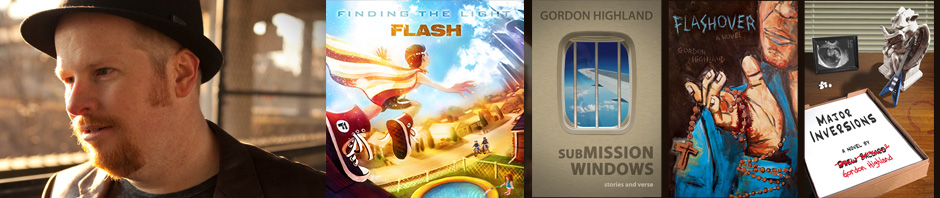
I’ve finally joined this social networking site for book nerds, with a reader profile and a book listing. Come add me as a friend, check out my collection, and/or follow my reviews. It works with Facebook, Twitter, and other social platforms. And if you’ve read Major Inversions, please give it a star rating, a short review, or simply add it to your “to-read shelf” until later.
Posted innews|Comments Off on Join me on GoodReads